
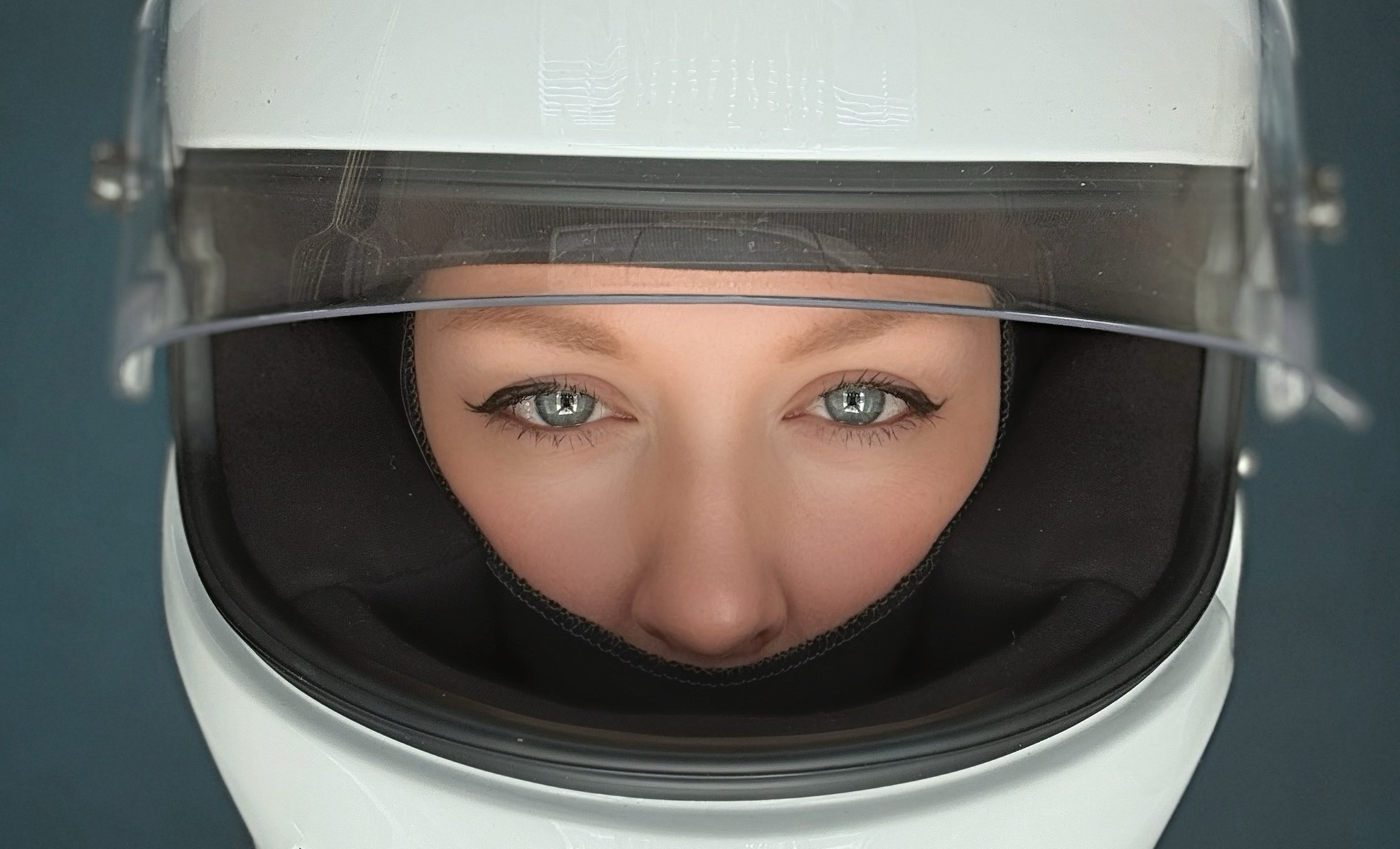
Brain-based therapies, such as Rapid Resolution Therapy, Brainspotting, EMDR (Eye Movement Desensitisation & Reprocessing), Somatic Therapy and Clinical Hypnotherapy, are types that work with the whole brain, not just your conscious, thinking mind like those used in traditional therapy.
They work with the deeper, subconscious mind and bring together the mind-body component of trauma or stuck areas, for a more complete healing from the bottom up and are often less invasive, shorter in timeframe, and are a more enjoyable therapy experience. Making them exactly the type of therapies that Sheri Johnson wanted to work with after completing her Master of Social Work degree.

Known professionally as Sheri Johnson and in the racing world as Elle, she is the owner of mental health counselling businesses in Canada and the USA. She has worked with thousands of clients through her career. Starting her own private practice offering virtual mental health counselling, and within three and a half years, Elle’s team has expanded to 18 therapists who are trained in traditional methods of treatment and also advanced, brain-based modalities.
“I never wanted to be a counsellor that just talked and hoped for the best. I only wanted to do this work if I could make a tangible difference for people. These brain-based methods allow me to shift things on a neurological and subconscious level of mind, not just talk about the problem. My therapy clients walk away with more immediate, noticeable changes and I see it as my responsibility to create a space and skillset where that is possible,” Elle shared with Driven Women Magazine.
In recent years Elle has also begun a sub-specialty in working with athletes. Offering brain-based performance coaching to people from all over the world, from student athletes to Olympians, from pickleball players to competitive surfers and karting drivers. Elle hopes to one day provide brain-based therapy and performance coaching to the motorsport and Formula racing world.
There’s also a synergy between high-performance athletes and high-performance cars, with both constantly pushing themselves to the limit. Whether in conditioning, body composition goals, frequency of training. It can be all encompassing, consuming every part of an athlete’s life, energy, relationships, and overall sense of balance. High performance athletes usually learn this level of discipline at an early age, and it’s part of who they are. Racing a competitive car means utilising it to its limits and that starts in the factory, then requires maintenance, upgrades, fresh tyres, and a team to keep it running optimally.
“I think this is what makes racing high performance cars such an incredible sport. You are the athlete, and so is the car, it becomes a doubles sport, because a race win depends just as much on the car (and everyone behind it), as it does the driver,” explained Elle.
This ambition for Elle to work in the world of motorsports stems from an interest in sports cars from an early age. Growing up in Vancouver, British Columbia, meant Elle always had an an active lifestyle, hiking in the mountains, basketball, running, much of which she still enjoys today. Her hobbies also include her dog, racing cars, rollerblading, and biohacking.
After high school, Elle started working at Toyota as a Warranty Clerk. She loved working in the Service Department with all the car guys. Since then, she has always had a deep appreciation for Japanese engineering, and seeing Toyota Gazoo Racing be revived in recent years and even running the Haas F1 car is really inspiring for her.
In 2016, a chance sighting of a white Porsche Cayenne literally stopped Elle in her tracks and she made herself a promise then and there that one day she’d get one for herself. However, that was before she discovered the more compact and quicker Porsche Macan, and in 2022 she was finally in the position to buy one of her own.
“I remember test driving the Macan base model and I was bummed about it. The sales lady looked at me like I was crazy. I said, ‘I need more power!’ I ended up buying the Macan GTS and I was determined to use it like it was meant to be,” said Elle.

Not wanting to waste a perfectly designed racing engine by only driving it to the grocery store and back, Elle went about sourcing a racing coach to train her on the race track. At first, she found it really difficult, with no response from the first dozen or so places that she contacted. Elle gave up for a while, but then when she was having a bad day, she said to herself ‘F this! I am going to get onto a track one way or another.’ Finally, through Instagram of all places, she received a response from Velocity Autosports.
“Within a week I was on track with my Macan GTS and Peter Skinner, the owner of Velocity, who has been a constant source of encouragement on my journey since. The Macan may be top heavy for the track, but it has a Sport Plus Mode on the 6-cylinder turbocharged engine that makes it roar. I get really giddy whenever I hit the throttle in that mode,” recalled Elle.
Elle had figured that just one track day would be enough to satisfy her, but that assumption was very wrong. She couldn’t stop thinking about it and was mesmerised by the combination of the sport, technical precision, and mental strength required. On the track, she felt like she couldn’t think of anything else, other than what she was doing, what was coming next. It was exactly what she needed in her life at that point and she was instantly hooked.
Her favourite car driven to date on a track, is the 2018 Porsche Cayman GTS and she admits that she is absolutely obsessed with the mid-engine, RWD flow of the Cayman. Under the tutelage of Mike Moore (Tower Turn Coaching & Chief Instructor at FARA Racing) driving his Cayman on her second ever track day at the Homestead-Miami Speedway in Florida, Elle distinctly remembers her third run on the track that day, “I suddenly felt everything click for the first time on track. There was this incredible feeling of calm, like I was just one with the car, every turn felt amazing, and I couldn’t stop smiling… it was flow state. At the time, I didn’t even know what that meant, but now I know it’s what so many racers chase.”


After eight months driving, Elle has recently graduated from Racing School and obtained her Novice Racing License with the CACC in Canada. She plans to compete both in Canada and the USA, hopefully with the support of some aligned sponsors who want to see more women in motorsport and it’s her dream to race with Porsche and Toyota Gazoo Racing.
As a therapist, Elle explained that there are many things happening all at once when you are on the track that you’re forced to be 100% present and that it is very difficult to get distracted. You’re not just stepping on brakes and throttle, but you’re looking ahead at the apex of the next turn, while determining when to start braking, when to turn in, then you’re trail braking, and making sure not to hit your apex too early or too late, and gearing back up on corner exit as fast as you can, while gradual enough to not spin out and lose control. Then passing cars on the straights so you can beat them before the next corner where you do it all over again and every corner requires a different strategy.
“It is actually very hard to think about anything else. To me, it is the ultimate mindfulness exercise. Most people think of mindfulness like meditation, but mindfulness is simply focussing on one thing that’s happening in the present moment and not on things that aren’t happening. Seems like such a simple thing, but it is really hard to do in everyday life with so much going on all the time. Once I’m on the tack, it’s like a reprieve from it all,” stated Elle.
The other component is that the stakes are so high when you’re going that fast, so if you start thinking about unrelated topics, it turns into an instant mistake on the track. Which you don’t want at 200+ km per hour. Elle wears an Ultrahuman Ring that shows her how fast her heart is pumping and whether she is in stress mode or workout mode.
“I compared my heart rate to my Coach, Pasquale’s heart rate on the same track in the same car, racing back-to-back, and my heart rate was working pretty hard, while his was completely even. Racing can be a really gruelling sport with all of the heat, the G-force, and the heavy pedals, but I really think you’ve mastered the mind when you can remain completely at ease when racing. It’s a goal I’m working toward,” said Elle.


Her work in brain-based therapies and with high-performance athletes gives Elle the resources to manage her brain better on the track as well. Elle found that when she was racing that she was holding her breath in the corners and breathing on the straights. So, she has been working on regulating her breath while on track. Regulated breathing not only lowers your heart rate automatically it also calms the fear centre of the brain, especially when lengthening the exhale. In addition, it releases excess carbon dioxide from the bloodstream, thereby clearing your mind, and allowing more responsiveness in decision making and movements.
Another very simple tool that Elle uses is to just look where she’s going on the track. Because if you’re always preparing for the next move, you can’t think about what happened before. Sometimes you make a mistake and you want to get bummed about it or it psychs you out, but focusing on what is next is what matters. If you focus on what already happened, you’ll make another mistake, guaranteed. Visualising the race beforehand is also a widely known technique to help improve results and the first time Elle did this, she felt noticeably more prepared once she was on track.
From a physiological standpoint the one thing Elle does for her brain before racing is drink high quality electrolytes so she’s hydrated, and to eat healthy fats on the day of competing. The brain relies on fat to function at its best. Avocado, olive oil or even Omega 3s give her brain a noticeable boost.
“I learned this in my work as a therapist. I need to be ‘on’ when I’m with clients, and it’s a very obvious difference with how helpful I can be, when I have had my fat snack. One time I had caffeine before some hot laps, and I noticed it really perked me up and sharpened my awareness. But I tend to crash from caffeine so I can’t have it if I’m going to be on track for a while through the day,” added Elle.

For women there’s often a more natural sense of cautiousness or protection because of our biology to procreate. Whereas men might have a more instinctual inclination to go fast now…even if they aren’t quite ready or don’t have the technical skills to do so. Elle thinks this results in more accidents and an earlier plateau in terms of skill development in men. Whereas women may take a wiser approach, learn the ropes, not push when they aren’t ready, and therefore develop at a steadier upward trajectory over a longer period of time.
From the start, Elle knew she could do this [racing] because something this technical, can be learned. And for her, she usually starts out slow with new things and when she understands the theory, it all comes together and then the progress is quite fast. People might think Elle is reckless for racing cars, but she knows that with the right coaching and commitment to learning it well, she can achieve her goals.
Racing cars can be a good form of therapy for some people because life is tough sometimes and driving a car skilfully at its limits feels like you’re taking back control, in a way. Pushing a high-performance car in the manner it was meant to be driven can also give you a sense of oneness with the car. It’s an entire mind-body experience and all of the stressors in life just dissipate according to Elle.
“I think this is what has fascinated me about racing the most,” concluded Elle.
Photographs Supplied.