
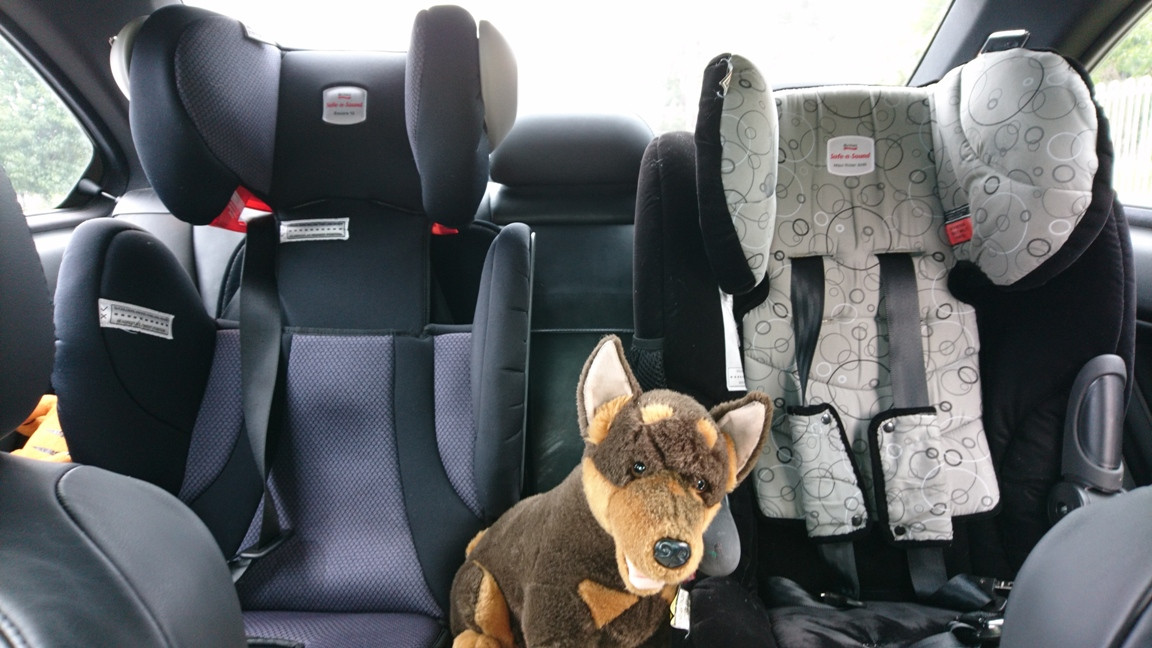
The recent addition of a new puppy into our family has been a reminder of how it feels to have a new born baby at home. Back then for me the sleep deprivation alone was enough to have me waking up in the morning questioning what day it was. Then thrown into the daily routine of feed, sleep, clean repeat, I would consider a win for the day if I managed to have a shower and got dressed into some clean clothes.
Why then would car companies want to make the installation of car seats any more confusing than it already is? After reviewing more than 450 cars one of my bug bears has become unlabelled rear tether anchorage points.

By not labelling all of these, car companies are leaving families guessing if a point in the boot that is behind the seat is or isn’t an anchorage point. A couple of more recent case in points are Range Rover Evoque and even the most family friendly of vehicles, the Volvo EX90. But there have been many others over the years.
Now I’m sure of you were to read the manual if would clearly tell you which points are anchors, but who has time for this when you feel like every day you are just running on survival mode for you and your new little one!
In the most extreme case I have seen, was the Ferrari Purosangue, and I know very few of us are going to have this problem. But the rear tethers points were actually behind a removable rear divider at back of boot. Worst of all there are tie down points for securing items in the boot that look potentially like anchorage points and the actual anchorage points aren’t even labelled as such.

“Clear identification of child restraint top tether anchorage points is important for correct installation – in particular differentiating between child restraint anchorages and other tie-downs, for which there are no defined strength or location requirements.
In Australia, anchorage design and labelling requirements are set through the Australian Design Rules (ADRs). Current requirements are inconsistent because they combine older Australian tether rules with newer international ISOFIX provisions. This means some centre seating top-tether anchorages are not required to be marked in the same way as outboard ISOFIX points,” said ANCAP Chief Executive Officer Carla Hoorweg when Driven Women Magazine questioned about this issue.


A more common issue that many families may face are anchorage points in many utes, which are now moving away from the tradie realm and into family car realm. My absolute pet hate is the seat belt style material points that you have to loop the rear tether strap through and then connect it to a centre metal anchorage point. As shown in the photos above from the Toyota Hilux.
It would be very easy for someone to just assume the loop behind the outer seat is the anchorage point and simply connect the car seat to that. So, I would like to see some indication here that these are not actually where you connect your car seat. Also, metal clips behind seats can be deceiving and look like anchorage points when they aren’t.


The Kia Tasman ANCAP Safety report states, “Installation of child restraints in the second row centre seating position is not recommended as there is no top tether anchorage.” Would it not be more accurate to say DO NOT install a child restraint here, rather than just “recommending” not to? See in the photos above how easily the centre latch point could be mistaken as an anchorage point for a child seat.
“ANCAP uses the wording ‘not recommended’ for positions (usually centre and third row seats) without a top tether because some child restraints, such as certain booster seats, may legally be used without a tether. ANCAP provides consumer guidance through these recommendations as ANCAP is not a regulator and regulatory requirements can vary between state jurisdictions. Further work to improve consumer information and clarity in this area is being considered,” added Ms Hoorweg.
Rather than “considering” further work to improve information about the correct use of rear tether points, I think ANCAP should in fact get on the front foot with some education regarding this as a matter of priority.
Road crashes are one of the main causes of injury-related deaths of children in NSW. Dr Julie Brown, a senior research scientist from Neuroscience Research Australia, was engaged by NSW Child Death Review Team to review the role of seatbelts and child restraints in passenger fatalities of children aged less than 13 years in NSW.
The report concludes that just over half of the 66 children who died in crashes over the 10-year period 2007 – 2016 were not properly restrained in the vehicle. Moreover, the lack or inappropriate use of seatbelts or restraints played a primary role in the death of almost one-third (20) of the children. In other words, many of the deaths could likely have been prevented if the children had been properly buckled up.
A report by the Queensland government on seatbelt and child restraint use in children 0–12 years in road crash child passenger deaths Queensland 2004–2023 found that approximately 75 per cent of fatally injured children (who were restrained during travel), were not restrained in accordance with best practice for their age. The data suggests there may be premature shifts in seat type, location and orientation before the child outgrows their existing restraint.
Australian laws relating to child restraint use and position of travel of children in the vehicle do not reflect evidence based safest practice and lag notably behind other high resource countries internationally. Isn’t it time we fixed this?
Photographs by Driven Women Magazine.